A Bible App for Real Life, Not Just Research
There is nothing wrong with wanting strong Bible tools.
Many people do want:
- fast navigation
- accurate text
- verse search
- reading plans
- better ways to study and understand Scripture
Those are good things.
But if a Bible app is built only for research-like use, it may miss a large part of what people actually need day to day.
Because most spiritual life does not happen in ideal study conditions.
It happens in real life.
That is also why a better KJV app should feel like it has a word for the moment you are in, not just a database waiting to be queried.
Real life is where most Bible-app moments happen
Real life looks like:
- checking a verse before work
- opening the app after an exhausting day
- needing one clear passage when your thoughts feel crowded
- trying to pray when you do not have many words
- returning after several missed days
These are not secondary moments.
For many users, they are the main moments.
That is why a Bible app for real life should do more than support research.
It should help people receive Scripture when energy, time, and attention are limited.
Research is one kind of use, not the only kind
Some people open a Bible app to study deeply.
They want to:
- locate passages quickly
- follow longer reading structure
- prepare for church or personal study
That should absolutely be supported.
But many people are not asking, “How can I do more research right now?”
They are asking:
- “Where do I begin?”
- “What can I read when I feel overwhelmed?”
- “How do I come back without pressure?”
- “What should I read before sleep?”
That is why devotional design matters.
A usable Bible app should reduce friction
When life is heavy, too much friction makes people drift.
They may still want Scripture.
They just do not want:
- too many choices
- too much mental load
- a sense of already being behind
This is why features that feel gentle are often more important than they first appear.
A Bible app for real life may need:
- shorter devotional entry points
- easier search by phrase or situation
- a bedtime-friendly reading path
- reading plans that feel guided
- a low-pressure way back
That is not lowering the seriousness of faith.
It is making spiritual practice more receivable.
People often need to be steadied before they are ready to study
This may be the most important point.
On some days, people do need insight.
On other days, they first need:
- comfort
- peace
- reassurance
- a brief prayer
- one verse they can actually hold onto
In other words, a person may need to be steadied before they are ready for more demanding engagement.
That is not a lesser use of Scripture.
It is often where faithful use begins.
What this looks like in actual devotional content
This is easier to understand with concrete examples.
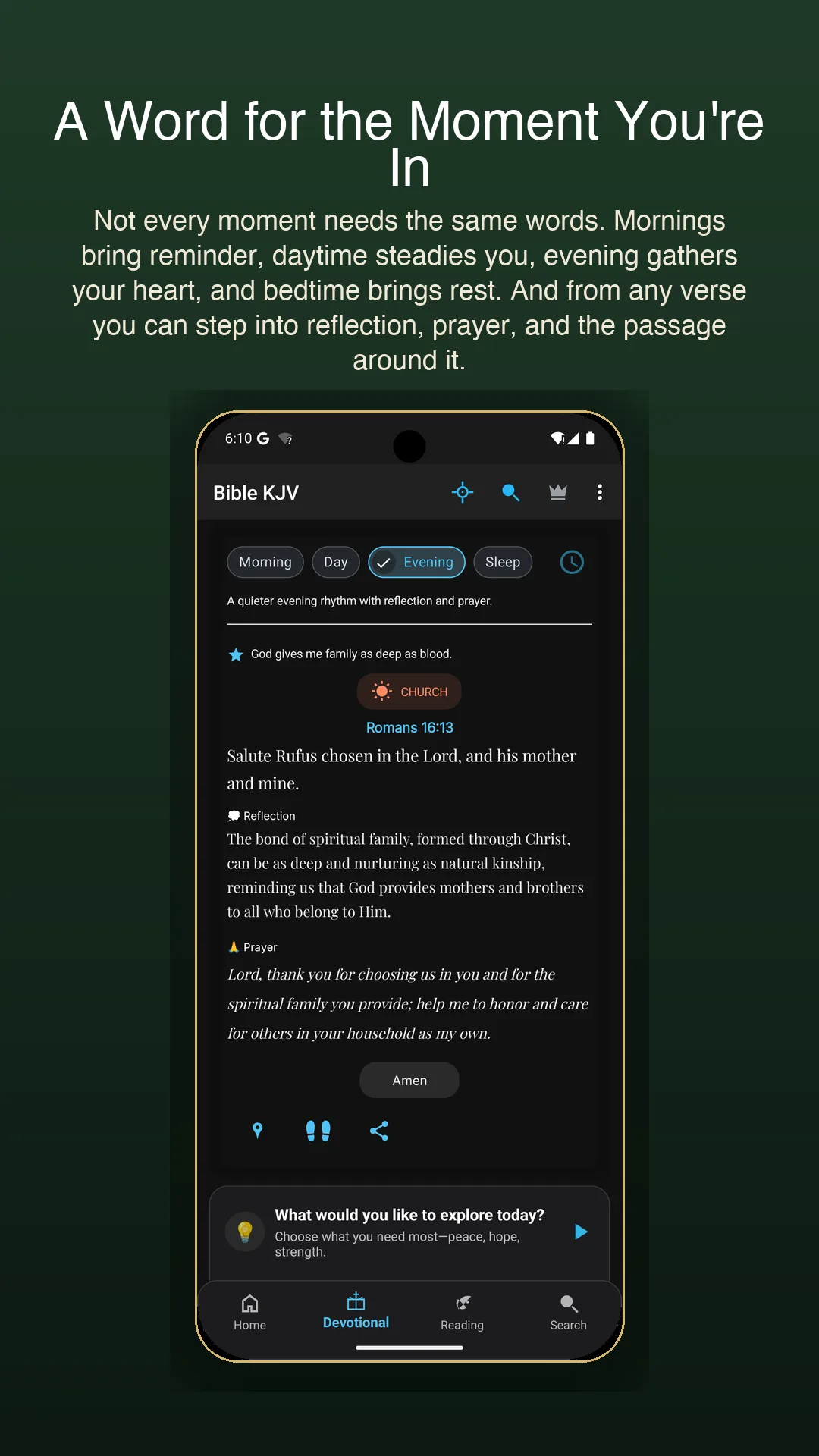
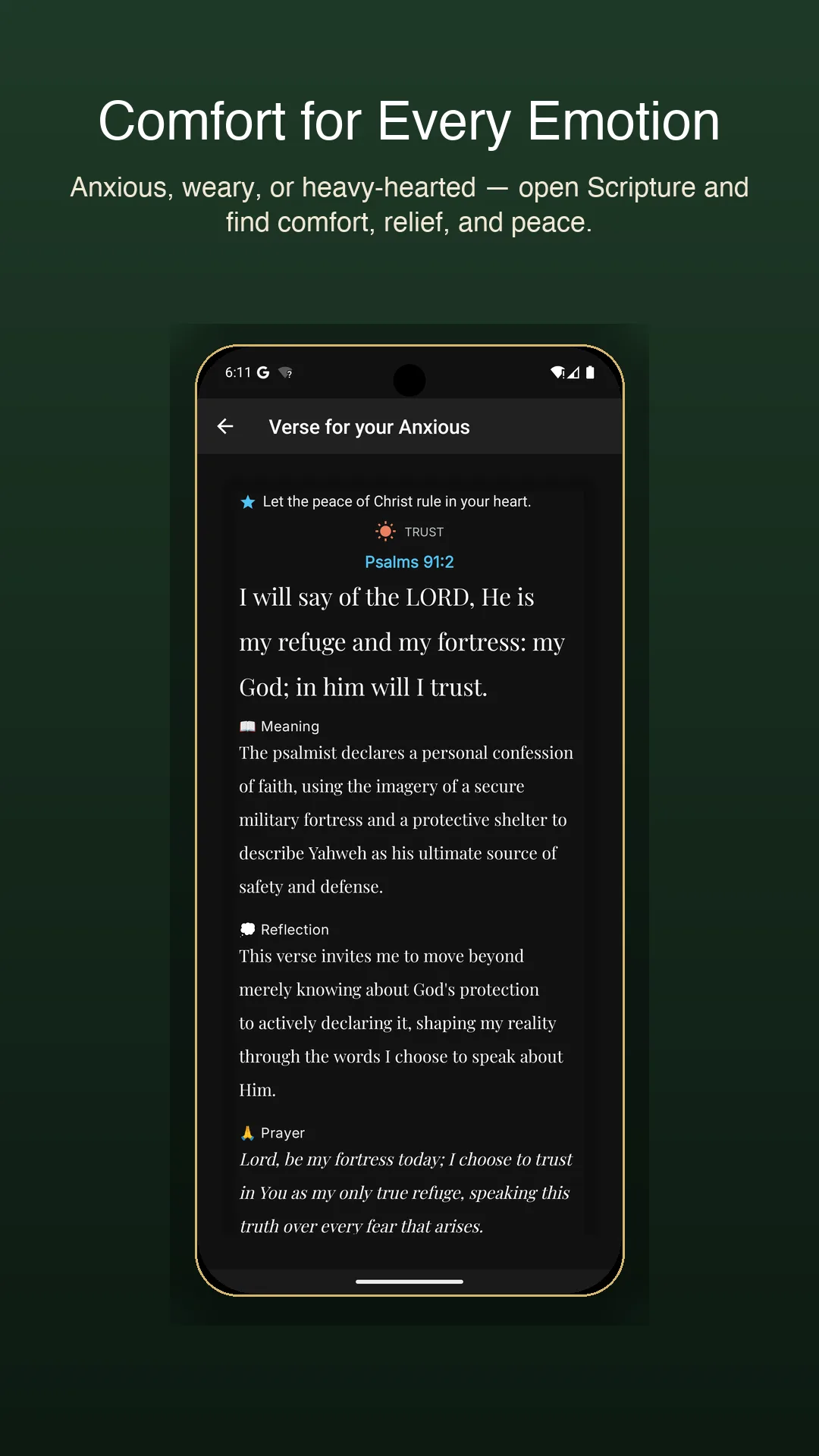
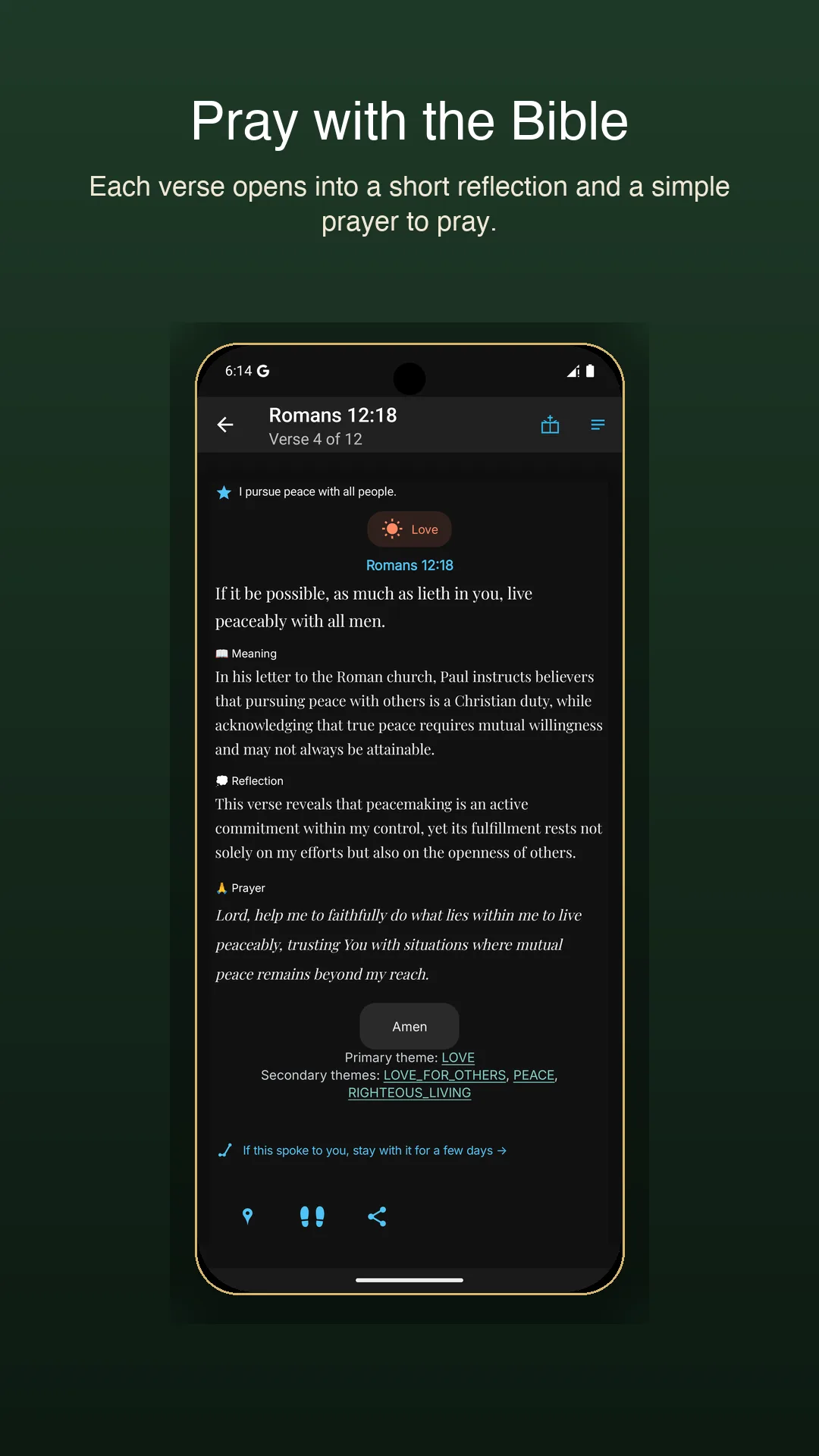
This is the larger product idea in visual form: Scripture can meet a person where they are, then open naturally into reflection and prayer rather than stopping at the verse itself.
In the current KJV devotional content, the app does not only store Bible text.
It also has a time-based Verse of the Day structure.
That matters because users are not really choosing between an internal full or compact model.
What they experience is more like this:
Morning / day / evening / sleep can each have a fixed VOTD verse
For each part of the day, the app can surface a fixed Verse of the Day for that slot.
So the first thing that changes is not only content length.
It is the verse itself.
A morning verse is chosen for morning.
A day verse is chosen for daytime.
An evening verse is chosen for evening.
A sleep verse is chosen for bedtime.
Morning can be shorter and easier to enter
Once that morning verse is fixed, the presentation can still stay brief, steady, and immediately receivable.
For example, a morning VOTD such as Matthew 11:28 can be surfaced in a short way:
I find rest in coming to Jesus.When I stop carrying my own burdens and bring them to Jesus, I find true rest.Jesus, I come to You with all my burdens.
That kind of presentation works well when a person needs one clear verse, one short insight, and one simple prayer before the day gets busy.
Daytime can carry a fuller devotional layer around its own verse
By daytime, the app can afford to give a little more around the verse chosen for that slot.
For example, a daytime devotional verse can be presented with fuller devotional language:
- Meaning:
Jesus speaks these words as the divine Son who reveals the Father, offering relief to those burdened by the weight of religious legalism and spiritual exhaustion. He presents himself as the gentle alternative to the harsh demands of the law, promising true spiritual rest to all who come to him. - Reflection:
The invitation reveals that rest is not found in ceasing activity, but in coming to a person. My weariness often stems from carrying burdens Jesus never asked me to bear alone. - Prayer:
Lord Jesus, I come to you today heavy with burdens I cannot carry. Give me the rest that comes from trusting your gentle yoke instead of my own striving.
That creates a different user experience from the morning layer.
Evening and sleep should not feel like daytime reuse
Later in the day, people are often carrying emotional weight, fatigue, and the need to let the day end well.
That is why the KJV line can keep shifting the presentation:
eveningcan lean more toward release, entrusting, and annual rhythmsleepcan become even softer, slower, and more bedtime-friendly
So the real product idea is not simply “short devotional versus long devotional.”
It is that the app can meet different hours with:
- a different fixed VOTD verse
- a different devotional tone
- a different depth of presentation
The reading-plan side can work the same way
The same idea shows up in the app’s devotional plans too.
For example, the 365-Day Devotional Journey is not just a long checklist.
Its first week follows the theme Trusting God, and the daily flow moves through:
encouragementinsightteachingreflectiondeep_challengeapplicationprayer_rest
Then week two begins God’s Presence, starting with Psalm 23:1.
That kind of structure matters because it gives people a spiritual journey, not only a reading schedule.
What this means for the KJV product line
For Bible KJV - Daily Devotional, this kind of positioning makes a lot of sense.
The app is not only trying to be a place to store the KJV Bible.
It can also be a place that helps users move through real-life moments with Scripture.
In other words, the product promise is not only “read the KJV.”
It is closer to: read, reflect, pray, and keep growing across the different hours of ordinary life.
That is where its structure starts to make sense together:
- offline KJV reading
- advanced Bible search
- richer reading plans
- Verse of the Day
- short devotional flow
- emotion-based devotional entry
- Take a Break for daytime emotion-based compact devotionals
- evening rhythm
- sleep audio devotional
These are not random extras.
They are answers to different kinds of real-life entry points.
A Bible app can serve both truth and usability
Sometimes product language gets pulled into a false choice:
- either serious Bible use
- or emotionally accessible devotional use
But a better Bible app should be able to do both.
It can respect Scripture deeply while also presenting it in ways people can actually receive on ordinary days.
That is what makes an app feel mature.
Not only that it contains the text, but that it understands the user’s moment.
Real-life spiritual help is not a side feature
For many believers, the most important thing a Bible app does is not simply helping them look up a passage.
It is helping them stay connected to God when life is:
- busy
- uneven
- discouraging
- mentally crowded
- harder than expected
That is why a Bible app for real life matters so much.
It keeps Scripture near not only in study time, but also in ordinary need.
Keep reading or try it
If you want a KJV Bible app built for both Bible reading and real-life devotional use:
- Read more about devotional features: /posts/kjv-bible-app-daily-devotional-features/
- Read this related piece: /posts/kjv-marketing/what-do-people-need-from-a-bible-app-today/
- Browse the KJV online: /kjv/
- Google Play: https://play.google.com/store/apps/details?id=com.gyc.ace.kjv
A Bible app should help with study when study is needed.
It should also help people live with Scripture on the kinds of days they actually have.